Showing posts with label Sámi. Show all posts

Thursday, January 15, 2015

Challenge 52 in 52: Sámi

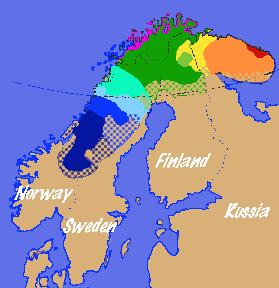
This is Máddji from Kautokeino, Northern Norway, and the Sámi they speak there is Northern Sámi, the form of Sámi with most speakers, spoken in Northern Norway, Sweden and Finland.


Iđitguovssus girdilit
Hávski lei go iđistit
Vilges dolggiid geigestit
Várrogasat salastit

Njukča, njuvččažan
Buokčal, ligge varan
Njukča, njuvččažan
Ovdal iđitroađi

Iđitguovssus girdilit
Hávski lei go iđistit
Jaskatvuođain savkalit
Nuorravuođain njávkalit

Njukča, njuvččažan
Buokčal, ligge varan
Njukča, njuvččažan
Ovdal iđitroađi

Riegádahte áibbašeami
Oktovuođa váillaheami


The lyrics are from YouTube, click the "watch on YouTube" link on the video

You flew in from the dawn
Such a sight when you came into view
You stretched your white wings
Careful embrace

Swan, my swan
Dive, heat my blood
Swan, my swan
Before dawn breaks

You flew in from the dawn
Such a sight when you came into view
You whispered softly
Youthful caress

Swan, my swan
Dive, heat my blood
Swan, my swan
Before dawn breaks

Bring out my yearning
The longing of the lonely

Sunday, October 30, 2011

Last day of my Sámi week

 This is a yoik by Jarŋŋa called Äno jiedna (the sound of the river)
No lyrics.

Well... it didn't go well. I was somewhat put of by the very limited resources. Don't get me wrong, there's plenty of resources around to get at least some understanding and knowledge of Sámi, but it's very... organized. I got the feeling you have to start from A and go on in straight line and without questions and opinions, just study the material given the way it is given etc. I didn't find it possible to easily start building your own sentences with the material given, and it is very Sápmi centered. Now, I understand why, but it means people won't study this language just for the fun of it, to be able to use it to chat with their language geek friends, or keep a diary on it, because there is very little kota, reindeer and saameting outside Sápmi.

I didn't write one flashcard.
I didn't study even the numbers. I lazily collected them, but I didn't study them.
I didn't study the alphabet, or even one line in Sámi.
I have been a bad girl.
I have just been listening to Ođđasat (news in Sámi) and some amazing music.

In less than 30 hours NaNoWriMo 2011 begins. I won't be giving my characters lines in foreign language, because I hate that in books, especially if it's not translated.
Now I don't remember how Tolkien used his languages, but I think it was mostly in short things, like magic words and saying that can't really be translated, or were translated...
I remember a school mate of mine, one of the "popular" girls, explained that one learns foreign languages from romance novels. Sure. "Cara mia!" I'd rather watch Addams Family :-D

Nevertheless, I don't think one should use the word "Elvish" of Elven languages. There are several and they have names. It's like saying "I'm speaking European!" But, alas, as a Tolkien fan, of course I have to learn Quenya and Sindar. :-D

BTW, I thought for long it's "Elvis-language" and wondered what was so special with Elvis... :-D

Elvish impersonator by Christopher


IPA

i - like ee in English word free [fɹiː]
ɨ - like e in English word roses [ˈɹoʊzɨz]
ɪ - like i in English word bit [bɪt]
ɪ̈ - like the last e in English word parallelepiped [ˌpæɹəlɛlɪ̈ˈpaɪpɪ̈d]

y - like u in French word chute [ʃyt]
ʏ - like ü in German word schützen [ˈʃʏtsˑn]

u - like oo in English word boot [bu̟ːˀt]
ʊ̈ - like u in English word euphoria [jʊ̈ˈfɔəɹiə]
ʊ - like oo in English word hook [hʊk]


Here's a video on how to pronounce that horrible ü [y] not know in English... Just repeat.


"You know how to whistle, don't you, Steve? You just put your lips together and... blow."
Just put your lips together like for a kiss and sound, and you'll produce ü.

Friday, October 28, 2011

Some language learning tips from studying Sámi


Davvin is a Sámi course written for the Finnish, Swedish and Norwegian stately broadcasting company. It gives a couple of suggestions on how to use the course, and I am going to say my meaning of a couple of them.

Firstly, it says that one should be able to repeat any discussions as any person participating. It reminded me of Leyla Randomness and her lovely video "Polyglotte2". She says her method is imitation :-)
Take a random dialogue and learn it as if it was your lines for a play, then play both (all) parts. Take any discussion, take your favorite discussion from a movie or series, and imitate, copy, parrot... act as if.

Secondly, it says that one should practice writing by dictation. You are to listen to a recording of a text you have. Stop the tape after every sentence and write it down. After you have written down all the sentences, check the spelling by the text. Repeat as many times as you need to get all right.
You get usually a recording with a language course, but if you don't have a course, there are some recordings with texts online. (For example Sámi, there are some songs with lyrics on-line.)
If nothing else, you can always read by your best ability, record the text on MP3 player or so, and then try to add the speed a little so that you get the speed up. I know this is not quite as good practice as having a native speaker saying something, but if that's all you have, it's better than nothing. Of course, your own pronunciation sucks, especially in the beginning, but it gives you SOME practice... besides, if you can't find anyone to speak the language to you, it doesn't matter too much if your pronunciation sucks... it will improve with time, I promise, when you get in the action.
Also, every beginner's pronunciation sucks. Some kids fight with the pronunciation for a couple of years to get it right, WITH THEIR OWN MOTHERTONGUE! :-D You just have to be ready to repeat, often, slowly and in the end on paper, to make yourself understood. If you need to take on paper and pen, ask the native speaker to repeat the word and sentence to you as many times as you need to get it right - or at least understandable ;-)


Now I have received a mail from my favorite book store in Finland, and they can get me the Estonian book - it would cost 26€, when in Estonia it would cost on half of that... >:->
Also, they can't get the other books. Any suggestions?

IPA

ɛ e - like e in English word bed [bɛd]
ə - like u in English word fur [fɜ̝ː] 
o - like eau in French word réseau [ʁeˈzo]
 œ - like eu in French word jeune [ʒœn] 
ɜ , ø , ɘ , ɵ , ɤ - like ir in English word bird [bɜːd] 
(or er in Gertrude, or ur in turn or ear in learn)
(There really is very little difference in these phonemes)
 
ɔ - like o in English word dog [dɔɡ] 
ɶ - like eu in French word honneur [ɔnɶ̝ʁ]

Wednesday, October 26, 2011

Liekkas


Liekkas

Nástegokčasa vuolde
mon ráhkadan luottaid
Guovssahasa sánit
libardit dáivahis

Jaskatvuođa háddus
mu vuoigŋamat davistit
Juoga savkala munnje
ahte leat boahtime

Doala mu gieđa
Njávkka mu niera
Savkal čáppa sániid
Jeđđe litnásit
Leage nu liekkas
vai mon in galbmo
Juoiggas vel munnje...

English Translation:

Warm

Under a blanket of stars
I'm leaving traces
as signs from the northern lights
flicker in the sky

In the care of silence
my breaths resonate
Something whispers
that you are on your way

Hold my hand
Stroke my cheek
Whisper beautiful words
Soothe me softly
Be warm
so I'm not cold
Give me a yoik...

I don't know how correct the translation is, but I love this song and her way of singing it :-)

---

I should really get going with the resources on the net. I have been hunting a dream of mine; to write a concise pharebook and dictionary about all the European languages, considering that there are less than 200 of them. I once had a phrase book over South-East Asian languages... it was my first contact with all of them. I didn't even know there were all those languages... So I set on writing a book like that, but about European languages. I suppose I should have done it then, when I thought there were about 50 languages in Europe :-D On the other hand, if I wait a couple of years, some 50 more languages will have died.
Anyway, in stead of studying Sámi, I have been studying European languages.


IPA

ʌ - like in English word plus [plʌs]

æ - like a in English word cat [kʰæt]

ɐ - like u in English word nut [nɐt]

a - like a in English word stack [stak]

ä - like a in French word patte [pät]

ɑ - like a in English word spa [spɑ̟ː]

ɒ - like o in English word hot [hɒt]

Tuesday, October 25, 2011

Discovery Sámi


Now, I find it really hard to know what she actually says, but the following might help a little.

Mun lean ... - I am ...
Mu namma lea ... - My name is ...

Mun lean sápmelaš - I am Sámi (of Sámi people)

Mun lean Rensjönes mu áhkku luhtte - I am at my grandmother's house at Reindeer Lake (Rensjö, in Swedish)
(áhkku is grandmother, old woman, great-aunt)

This is my favourite place on earth.
báiki máilmmes/máilbmes- place on earth.
vuordámuš  -  expectation; hope ?
dá  -  here (in this place)
son lea - he/she/it is
dá lea here is

My grandmother has taught me all about Sámi traditions.
oahpahit - to teach
has taught? lea oahpahu?

I'm so thankful that I'm able to learn from her.
giitalit - to thank

I started to joik when I was young.
Mun álgin juoigat go mun ledjen unni
('unni' - small, not young, which is 'nuorra')

Joiking is a way of expressing your feelings.

geaidnu - way

When I'm happy, the joik i shappy,

go mun lean ilolaš, --- ilolaš luohti

and when I'm out in nature I sing what I see.

meahcci - forest, wilderness, nature

Every time I joik, my link to the Sámi way of life becomes stronger.


There is so little information available online, and I don't have any textbooks, grammars, dictionaries or anything with me right now, so this is so difficult it makes me want to cry... :´( It feels so frustrating and impossible.

Gulahalan is really good in the sense of teaching you the idea of the language. One could use it to "sentence mine".
This list of words was very good
Also, I found a PDF Northern Sámi lessons - I don't know which one was first, this thread in UniLang, or that PDF...

I suppose it's just to learn all that, and then try again.

Monday, October 24, 2011

Week 3: Sámi

Let's see what's out there about Sámi

Sámi language
Árran - Sámi culture and news blog
Oahpa
Lohkan
Gulahalan
Isak saba senteret
North Sámi word list
Partial Swadesh list for North Sámi
Omniglot's North Sámi
Etymological database of the Sámi languages 

Games and such - in Norwegian
Some more games

Northern Sámi in Wiktionary
Saamic profile at Learn Any Language
Unilang Sámi
Davvisamégiell grammar

Here's some worksheets

Yle Areena has some tv shows, like news, in North Sámi
(If you find nothing, search with "Oddasat", which is "News" in Sámi)
Yle Sapmi

Wikipedia in Sámi :-D

About Sámi culture


The Sami languages are spoken across northern Scandinavia (Norway and Sweden), Finland and Russia by more than 20 thousand people.

There are nine Sami languages, six of which are written:
Davvi or Northern Sami (about 21.000 speakers)
Inari Sami (300)
Skolt Sami
(420)
Kildin Sami
(500)
Åarjel or Southern Sami
(600)
Lule Sami
(2000)
The other Sami languages all have less than 20 speakers,
Ter Sami
Pite Sami
Umea Sami

When I think about this I wish I was really, really, really rich, so that I could buy Kuola from Russia, and Lapland from Norway and Sweden (okay, Finland too) and make Sapmi independent... I am ashamed by being a member of an occupying force, about what we - Finns, Russians, Norwegians and Swedes - to the Sámi people, how we have forced them to give up their religion, language, culture, traditions, to take on ours, which is supposed to be better, somehow... At the same time we have exploited their lands and waters, built water plants and mined and done all kinds of stuff like that. Real, proper imperialistic swine...

Now, I am going to study mainly the Northern Sámi, which is the biggest language/dialect spoken in Finland and Sweden. We have news in Sámi in television, and it would be nice to understand what they say.


Northern Sámi is a SVO language.

The alphabet has 29 letters:

Here's how they are pronounced.

"Northern Sami is an agglutinative, highly inflected language that shares many grammatical features with the other Uralic languages. Sami has also developed considerably into the direction of fusional and inflected morphology, much like Estonian to which it is distantly related. Therefore, morphemes are marked not only by suffixes but also by morphophonological modifications to the root. Of the various morphophonological alterations, the most important and complex is the system of consonant gradation."
Yep, quite a lot like Finnish and Estonian.

Sámi has 7 cases, 3 numbers - singular, plural and dual - they have pronouns expressing that there are two of us doing things... or two of you, or two of them. :-) I like that.
3 persons, 4 moods, 4 tenses and 1 gender. Simple.


Numbers in Northern Sámi

1    -    okta
2    -    guokte
3    -    golbma
4    -    njeallje
5    -    vihtta
6    -    guhtta
7    -    čieža
8    -    gávcci
9    -    ovcci
10    -    logi
11    -    oktanuppelohkái
12    -    guoktenuppelohkái
13    -    golbmanuppelohkái
14    -    njealljenuppelohkái
15    -    vihttanuppelohkái
16    -    guhttanuppelohkái
17    -    čiežanuppelohkái
18    -    gávccinuppelohkái
19    -    ovccinuppelohkái
20    -    guoktelogi
21    -    guoktelogiokta
22    -    guoktelogiguokte
23    -    guoktelogigolbma
30    -    golbmalogi
40    -    njealljelogi
50    -    vihttalogi
60    -    guhttalogi
70    -    čiežalogi
80    -    gávccilogi
90    -    ovccilogi
100    -    čuođi
1000    -    duhat

Meeting, greeting and being polite

Hello/hi: Heior Buorre beaivvi
Good morning: Buorre idit
Good evening: Buorre eahket
Good night: Buorre idja
How are you: Mii gul'lo?
Very well, thank you.: Buorre, giittus eatnat.
Goodbye: Oaidnaleapmái
Thank you: Giittus / Giittus eatnat
I don't understand: Mun in ádde
I don't know: In diede
Yes: Joo
No: Ii
Excuse me/sorry: Ándagassii
That doesn't matter/No problems: Ii das mihkkege